



MBBS (Singapore), MRCS (Edinburgh)
MMed (Orth), FRCS Orth & Tr (Edinburgh)
Returning to sport after an injury is not simply a matter of waiting for a certain amount of time to pass. Your readiness depends on how your recovery has progressed and whether your body can cope with the activity you want to resume.
The decision can therefore involve several considerations that may not be obvious during day-to-day recovery. Understanding what a sports injury specialist looks for can give you a clearer idea of what being ready to return to sport actually means.
Has the Injury Healed Sufficiently?
Before considering your return to sport, your sports injury doctor will assess whether the injured tissue has recovered sufficiently. Healing rates vary depending on whether the injury affects a muscle, tendon, ligament, cartilage or bone.
The assessment may take into account:
- The type and severity of your injury
- How long it has been since the injury or treatment
- Any remaining swelling or tenderness
- Findings from your physical examination
- Imaging results, where relevant
- Your progress during rehabilitation
This is particularly important after a significant injury or surgery. You may feel comfortable during everyday activities while the affected tissue is still recovering and not yet ready for higher physical loads.
Have You Regained Enough Strength?
Injury and reduced activity can cause the muscles around the affected area to lose strength. Even when discomfort has settled, weakness may remain and affect your ability to perform more demanding movements.
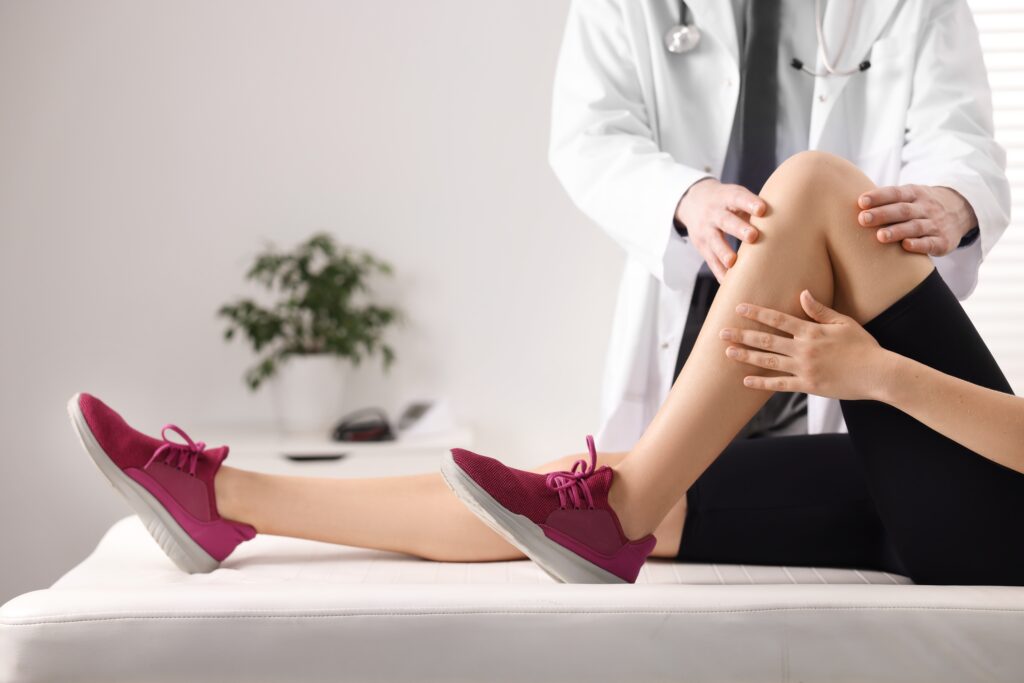
Your specialist may compare strength between your injured and uninjured sides. After a knee injury, for example, the quadriceps and hamstrings may be assessed to identify any remaining differences.
However, strength is not judged against the other side alone. What you need also depends on the activity you want to resume. A recreational runner, footballer and tennis player place different demands on their bodies, so your sporting goals form part of the assessment.
Have You Regained Adequate Mobility and Joint Stability?
A sports injury specialist may examine several aspects of how the affected area moves and functions. Even after the injury has healed, limitations in mobility or control can affect how comfortably and effectively you perform more demanding movements during sport.
Range of Motion
Restricted movement can alter how you perform an activity and cause other parts of your body to compensate. Your specialist may check whether you have regained the range of motion needed for your sport.
Joint Stability
Stability can be particularly important after ligament injuries involving areas such as the knee or ankle. Your specialist may assess whether the joint remains adequately supported when you move or place weight through it.
Movement Control
Your muscles also need to coordinate effectively to control the joint. Poor control may become apparent when you squat, land, turn or shift your weight, even when basic strength appears satisfactory.
What Does Functional Testing Assess?
Functional testing helps show whether your recovery translates into the movements required for your sport. The tests used will depend on your injury, activity and level of participation.
These may include:
- Single-leg balance or squats
- Hopping and landing
- Running and accelerating
- Jumping
- Cutting or changing direction
- Throwing or overhead movements
Your specialist will look at more than whether you can complete each task. Balance, coordination, technique and differences between the injured and uninjured sides can reveal limitations that are not obvious during everyday activities.
Testing may also reflect the specific demands of your sport, such as repeated impact for running or rapid changes of direction for football. How well you maintain control as you become tired may also be considered.
Do You Feel Confident Using the Injured Area?
Physical recovery is only part of returning to sport. Your confidence in the injured area can also influence how you perform.
You may hesitate before landing on one leg, avoid fully loading the affected side or change how you move because you are worried about another injury. These behaviours can sometimes persist even when strength and mobility have improved.
Discussing these concerns with your specialist or rehabilitation team can help identify where you need more practice. Gradually progressing through increasingly challenging movements can also help rebuild confidence before you return to unrestricted sporting activity.
Moving Towards a Safe Return to Sport
Getting back to a sport you enjoy can be an important milestone after an injury, but there is no need to measure your progress against a fixed timeline. Knowing where you are in your recovery can help you make a more considered return and address any remaining concerns before you resume your usual level of activity.
At Quantum Orthopaedics in Singapore, your recovery can be assessed in the context of the sport and activities you hope to resume. Care is provided by Dr James Tan Chung Hui, senior consultant orthopaedic surgeon with experience in sports surgery and exercise medicine. Arrange a consultation to discuss the next stage of your recovery today.
Our Specialist at Your Service
Dr James Tan Chung Hui
MBBS (Singapore), MRCS (Edinburgh)
MMed (Orth), FRCS Orth & Tr (Edinburgh)
Dr James Tan Chung Hui is a Senior Consultant Orthopaedic Surgeon with over 15 years of experience in sports surgery and exercise medicine. He specialises in knee, shoulder and elbow injuries, including minimally invasive ligament and tendon repair, cartilage procedures and joint reconstruction. Dr Tan has treated national athletes and professional footballers and is actively involved in research and tissue engineering collaborations. He is an Adjunct Assistant Professor at NUS and a Fellow of the Royal College of Surgeons (Edinburgh).